- Free Shipping On Select Items
- Free Sample
- Sign Up and Save


Wire Mesh for EMF Shielding: What You Need to Know
Electromagnetic field (EMF) shielding is used to block or redirect electromagnetic radiation and radio frequencies with conductive or magnetic barriers. EMF shielding is a common practice among lab administrators to block electromagnetic interference (EMI) from disrupting sensitive equipment or hardware testing.
What kind of wire mesh should you use for EMF shielding in lab environments? This guide shares why you should choose copper mesh for EMF shielding, Faraday cages, and grounding. You’ll also explore key selection factors to help you find the best wire mesh for your needs.
Why Is Copper the Standard for EMI/RFI Shielding?
There are a couple of primary reasons why copper wire mesh is the standard for EMI/RFI shielding. First, this material is highly conductive, meaning it efficiently reflects and absorbs electromagnetic energy. In lab environments, copper mesh can be used to wrap individual instruments or even line the walls, ceilings, and doorways of sensitive testing rooms. Copper mesh helps protect delicate equipment and data integrity from interference from nearby electronics or power systems. Secondly, copper is malleable and can easily be formed into panels, enclosures, wraps, or custom shapes for lab equipment and rooms. This flexibility helps labs avoid making costly structural changes.
Compared with nickel-plated or stainless steel mesh, copper wire mesh is the best option due to its unique properties. Nickel-plated and stainless steel offer more corrosion resistance and durability in harsh environments but fall short of copper’s conductivity, making copper the ideal choice when shielding effectiveness is the top priority.
How to Select Copper Wire Mesh for EMF Shielding
Now that we’ve discussed why copper wire mesh is the best choice for EMF shielding and Faraday cages, let’s get into how to select the right mesh type for your needs.
Mesh Count
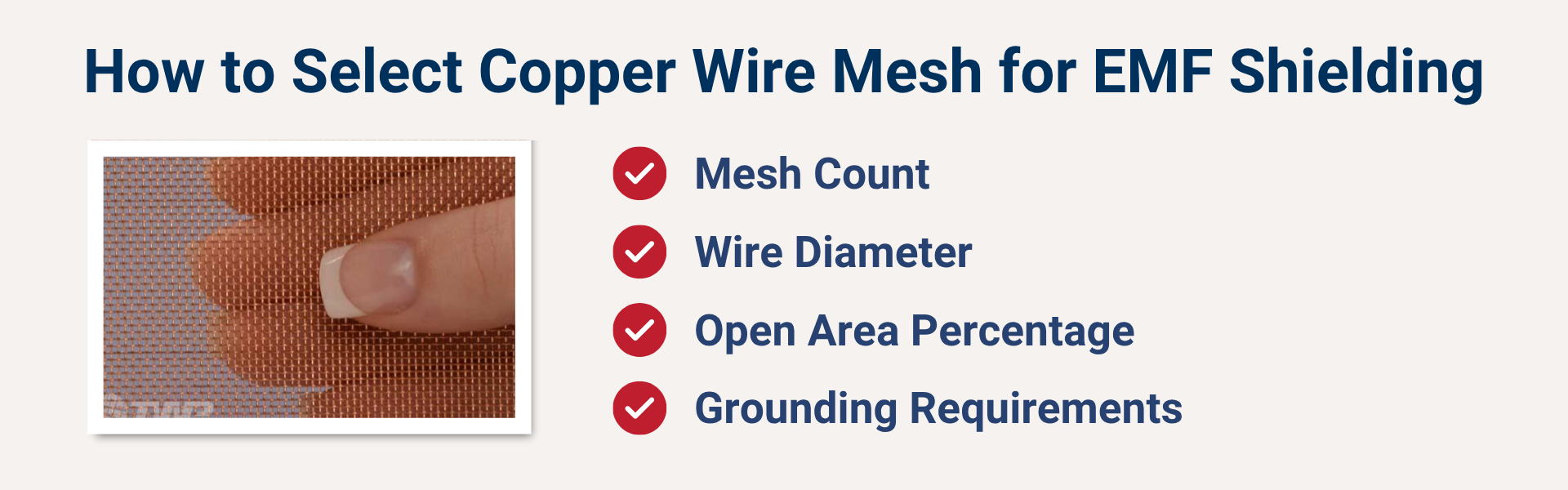
Mesh count is defined as the number of wires per linear inch in mesh. The higher the mesh count, the finer the shielding for blocking high-frequency interference. However, the trade-off is that finer mesh counts lack open area and reduce airflow. The best advice is to match mesh count to the frequency range your lab needs to block.
For instance, if your lab requires shielding against high-frequency sources like Wi-Fi routers or RFID readers, you may need a finer mesh, often 50-count mesh or higher, to block those wavelengths effectively.
Alternatively, a lab concerned with lower-frequency interference from nearby motors or power lines may want to use a coarser mesh, such as 20- or 30-count mesh, which provides adequate shielding and offers better visibility and airflow.
Wire Diameter
Wire diameter directly impacts mesh’s durability, weight, and overall shielding performance. Thicker wire diameter offers greater structural strength and is ideal for repeated handling. Panels that must be installed and removed often can benefit from thicker wire. The drawback is that thicker wires reduce the mesh’s open area, limiting airflow and visibility.
In labs, stationary installations can use thinner wire without sacrificing performance, but equipment that requires frequent access may need heavier-gauge mesh for durability purposes.
Open Area Percentage
Open area percentage refers to how much empty space is within a mesh pattern, and directly affects the balance of shielding effectiveness, ventilation, visibility, and light transmission. A lower open area percentage improves shielding performance but also restricts airflow and makes it harder to see through the mesh. A higher open area percentage enhances airflow and visibility but reduces shielding effectiveness.
This is especially important in labs where equipment may generate significant heat and require consistent airflow to prevent overheating. Additionally, some labs may require visual monitoring of shielded equipment, which you should consider when selecting copper wire mesh.
Grounding Requirements
Without proper grounding, even the best copper wire mesh won’t perform effectively. Shielding mesh requires a path to dissipate captured electromagnetic energy so it doesn’t re-radiate interference and undermine the whole setup.
Mesh installations should maintain continuous electrical contact across all seams and panel connections and use dedicated bonding points to tie the mesh to the facility's grounding system. Gaps or loose seams diminish shielding integrity and create weak points for leakage.
Grounding requirements vary based on facility layout and lab standards, so it’s recommended to work with facility engineers to confirm any shielding installation meets code and performs as intended.
Shop Copper Wire Mesh for EMF Shielding
Since 1969, TWP Inc. has been a proud woman-owned provider of copper wire mesh for EMF shielding and other applications. Our copper mesh meets ASTM E2016-22 and ASTM E2016-15 standards, ensuring quality performance in RFI shielding. We also offer custom in-house laser-cutting services for those seeking mesh tailored to specific specifications.
Shop our selection of high-quality copper mesh, and filter by wire diameter, mesh count, opening, width, and finish. We offer 99+% commercially pure copper mesh in a wide variety of weaves and sizes, in stock and ready to ship.