- Free Shipping On Select Items
- Free Sample
- Sign Up and Save


Highway Construction Runs on Wire Mesh

Ever since former President Dwight Eisenhower signed the Federal Highway Act of 1958, highways across the nation have had wire mesh incorporated into their construction. The versatile material allowed concrete to be laid quickly and with less labor involved than other methods. It also made superhighways like the Pennsylvania Turnpike, Indiana Turnpike, and the New York State Thruway tough enough to withstand heavy traffic.
Wire mesh is a staple for industries across the board. It’s used in architecture, wall and rock retention, and bridge maintenance. The first time wire mesh appeared on a major highway was in 1908 on the Long Island Parkway. The reinforcement weighed just 0.2 pounds per square foot. As time passed and technology improved, many states began requiring wire reinforcement in their roads.
Construction and building mesh for highways still offers a series of advantages:
-
- Welded wire mesh is made out of high-yield steel that can be 25% stronger than rebar.
-
- Steel used can be conserved by 27%.
-
- Wire meshes vary by material and size, and some are engineered to resist rust and corrosion.
-
- Placing concrete pavement takes up to 20% less time with wire mesh than with rebar.
-
- This means workers can beat changing weather, keep lane closures short, and cut down on traffic congestion.
-
- Workers are better protected from worksite accidents with an easier placing process.
-
- Public safety is improved with a resilient surface that can weather natural disasters including earthquakes.
Welded wire mesh for highways can come in a variety of jointed reinforced concrete pavement or continuously reinforced pavement. The mesh comes in a large sheet, which can be as big as 13 feet by 40 feet.
Building and construction meshes have been a boon to many highway projects.
Impressive 1-57
Outside of Champaign, Illinois, the welded wire mesh used for building 1-57 helped the interstate route last 30 years. A three-mile section developed no major or intermediate stress cracks or displaced joints—without ever getting an overlayment.
"Based on the research, the concerns some design professionals have about the use of welded wire reinforcement are not justified," Southern Illinois University professor Luke Snell wrote in a 1999 study of the highway. "The cover of WWR can be controlled within specification limits if the reinforcement is in sheet form and adequate supports are provided."
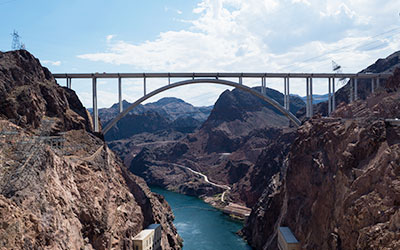
Hearty Hoover Dam Bypass Bridge
In 2010, the Mike O'Callaghan-Pat Tillman Memorial Bridge opened to manage growing traffic and mitigate safety issues. This bridge was a major component of the Hoover Dam Bypass project and was the first concrete-steel composite bridge in the country.
Mighty Metro-North Beacon Rail Line Bridges
In 2018, the New York State Department of Transportation began a $15.8 million project to remove and replace old bridges on Interstate 84. More than 50,000 vehicles use the highway daily. The new bridges will contain abutments reinforced with wire mesh and shotcrete.
Wire mesh has a number of other uses for highway construction, as well. They include repairing upper layers of preexisting road to cut down on pavement deformation, such as deep rutting and reflective cracking. The material is particularly helpful on soft ground to increase pavement bearing capacity.
TWP Inc. supplies wire mesh worldwide. Contact us today.